
How an AI Game Agent Handles Game Logic, Design, and Assets Automatically
Before AI agents existed in game creation, each of those three things — game logic, design, and assets — was its own discipline. Logic meant programming. Design meant planning systems and structures. Assets meant art. You either learned all three yourself, hired people with each skill, or made peace with having glaring weaknesses in at least one area.
The AI game agent doesn’t make those disciplines disappear. It takes on the execution of all three simultaneously, working from a single description of what you want. That’s what makes it categorically different from the tools that came before it. A vibe coding game session — where you start with a feeling and let the AI figure out the structure — only works because an agent can hold all three of these systems in mind at once and make sure they stay consistent with each other.

Three Things That Used to Each Require Their Own Specialist
Logic, design, and assets don’t just need to exist independently. They need to work together. The enemy sprite has to match the visual style of the background it moves against. The difficulty ramp has to align with the player’s growing understanding of the mechanics, the scoring system has to reinforce the behaviours the design is trying to encourage.
When those three things are handled by three different people — or three different tools — keeping them consistent is a project management problem on top of a creative one. The agent removes that layer because it’s holding all three simultaneously.
Game Logic: Rules, States, and Behaviours Generated on the Fly
Game logic is the invisible layer that makes everything work. When the player touches an enemy, what happens? When the timer hits zero, what triggers? And when all the coins are collected, what changes? These are rule systems, and they have to be built correctly, or the game breaks in ways players find instantly.
The agent generates this logic from your description of how the game should behave. If you say ‘enemies patrol back and forth and chase the player when they get close’, the agent writes the patrol behaviour, sets the detection radius, and handles the state transition from idle to chase — all from that sentence.
Seeing Boo Handle Logic, Design, and Assets on Combos
Step 1: Open combos.fun and describe a game with at least two distinct mechanics — watch how Boo plans both
The more moving parts your description includes, the more clearly you can see the agent’s planning in action. Describe a game where the player has to both fight enemies and solve environmental puzzles, for example. Watch how Boo’s GDD separates and connects those two systems.
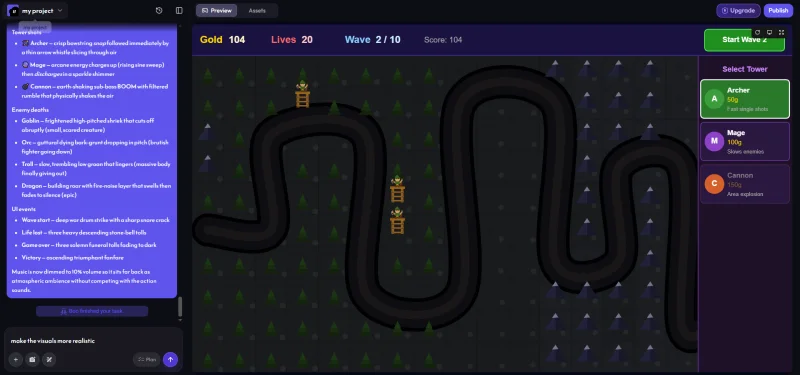
Step 2: In the GDD, notice how Boo defines game states, win conditions, and entity behaviours unprompted
You didn’t ask for a state machine. You didn’t specify what happens when the player dies. Boo includes those definitions anyway, because any complete game needs them. That unprompted completeness is what separates an agent from a generator.
Step 3: Approve and let Boo generate — it creates matching assets and integrates the logic in a single automated pass
The visual assets Boo generates are shaped by the logic it built. Enemy sprites look like the kind of threat the behaviour system describes. Rewards look visually distinct from hazards. The colour palette matches the tone. This isn’t manual curation — it’s the agent maintaining consistency across the three layers as it builds.
Step 4: Use the no-code editor to inspect and tweak any individual system — the agent’s work is fully editable
Nothing the agent builds is locked. Every mechanic, every asset, every rule can be adjusted through the visual editor or through natural language feedback. The agent built the foundation — you’re not stuck with it if something doesn’t work.
Design Decisions the Agent Makes (and the Reasoning Behind Them)
Design is where the agent is making the most judgment calls. When you describe a horror game, it chooses a pacing structure that builds dread rather than excitement. When you describe a game for children, it selects visual styles and difficulty curves appropriate to the audience. These decisions aren’t random — they’re grounded in what makes games in those categories work.
You can override any design decision the agent makes. But it’s worth examining them before you do. Sometimes the agent’s instinct is better than what you would have specified, because it’s drawing on patterns from thousands of games in that genre rather than your memory of the last two you played.
Asset Generation: Visuals That Match the Game’s Tone Without Manual Work
Every asset the agent generates is created in response to the game it’s building, not sourced from a generic library. Characters look like they belong in the world. Backgrounds support the mood rather than clashing with it. UI elements are readable and stylistically consistent.
That consistency is harder to achieve than it sounds, especially when you’re working alone. Mixing a pixel art character with a realistic background, or using a playful font in a horror game, are the kinds of mistakes that happen when assets come from different sources. The agent avoids them by generating everything from the same set of constraints.
The Result: A Cohesive Game From a Single Starting Point
So the thing that’s easy to undervalue until you’ve experienced it is coherence. A game where everything belongs together — where the logic, design, and visuals feel like they came from the same creative vision — is a meaningfully better experience than one where each layer was assembled separately.
The agent produces coherence by default because it’s working from one description and maintaining consistency across all three layers as it builds. That coherence used to require either a single developer with all three skills or a tight creative director managing specialists. Now it’s something the agent handles automatically.
Conclusion
An AI game agent handling logic, design, and assets simultaneously isn’t just a productivity win — it’s a qualitative shift in what a solo creator can make. The result is more consistent, more complete, and ready to play faster than any workflow that treated those three layers as separate problems.
Ti potrebbe interessare:
Segui guruhitech su:
- Google News: bit.ly/gurugooglenews
- Telegram: t.me/guruhitech
- Facebook: facebook.com/guruhitechfb
- Instagram: instagram.com/guruhitech_official/
- X (Twitter): x.com/guruhitech1
- Bluesky: bsky.app/profile/guruhitech.bsky.social
- Rumble: rumble.com/user/guruhitech
- VKontakte: vk.com/guruhitech
- MeWe: mewe.com/i/guruhitech
- Skype: live:.cid.d4cf3836b772da8a
- WhatsApp: bit.ly/whatsappguruhitech
Esprimi il tuo parere!
Ti è stato utile questo articolo? Lascia un commento nell’apposita sezione che trovi più in basso e se ti va, iscriviti alla newsletter.
Per qualsiasi domanda, informazione o assistenza nel mondo della tecnologia, puoi inviare una email all’indirizzo [email protected].
Scopri di più da GuruHiTech
Abbonati per ricevere gli ultimi articoli inviati alla tua e-mail.