
How Is Your IP Geolocation Estimated?
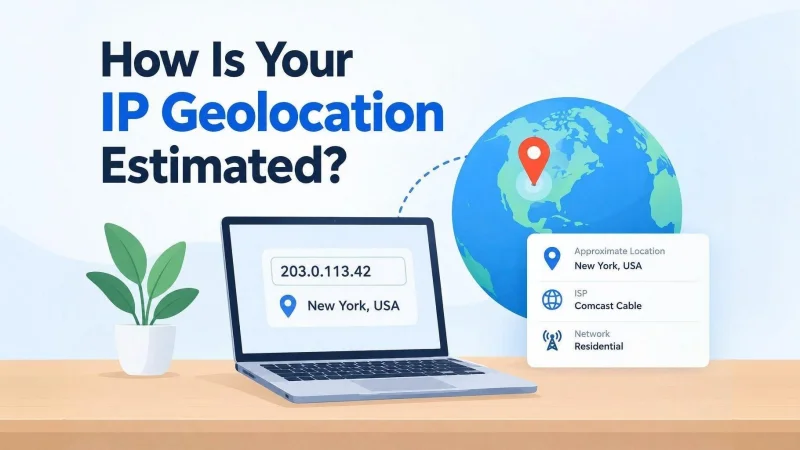
Sometimes when we visit a website, our country, city, or IP address is shown on the screen. Have you ever thought about where that information comes from? Is the website tracking your device and information?
Whenever you visit a website, they know your public IP address. And using that address, they find your geolocation and some other information. This location is the estimated location of your region and city. It is not your exact location. Because IP geolocation doesn’t work like GPS, it usually can’t tell your exact home address.
What Is IP Geolocation?
IP geolocation means finding an estimated location from an IP address. When you connect to the internet, your device uses a public IP address that is assigned to your connection by the internet service provider.
Geolocation services keep large databases of IP addresses. These databases link IP ranges with location data. When you check an IP address, the service looks for it in its database. It then shows the estimated location linked to that IP.
FYI: this location is not your exact physical location.
Using IP address checker, you can easily geolocate any public IP online. The results can vary from one service to another. This happens because each service may use different data sources.
How Does IP Geolocation Work?
The process may sound complex, but the basic idea is simple.
1. Your ISP gives you an IP address
Your ISP gives your connection a public IP address. The address does not directly contain your city or country. Instead, geolocation services use other data to connect the IP with a location.
2. The IP belongs to an IP range
ISPs and other organizations receive blocks of IP addresses. For example, an ISP may control a large range of IP addresses. It may use these addresses for customers in a certain area. Geolocation providers use this information as one clue.
3. The service checks its database
When you enter an IP address into a geolocation tool, the tool checks its database. The database may contain information about:
- The IP range
- ISP
- Country
- Region
- City
- Time zone
- Network type
IP geolocation finders display the estimated location based on the aforementioned data. This does not mean the IP proves that the user sits in that exact city. It only means the database links that IP with that location.
Where Do IP Geolocation Services Get Their Data?
Geolocation providers use many sources to build and update their databases.
Internet Service Providers
ISPs play a major role. They receive IP address blocks and use them across their networks. This gives geolocation companies useful information about IP ranges.
Regional Internet Registries
Organizations such as ARIN, RIPE NCC, and APNIC manage IP address resources in different parts of the world. Their records can help geolocation services understand who controls an IP range.
Network and Routing Data
Internet traffic moves through many networks and routers. This network data can give more clues about where an IP address may operate.
Some providers also use data from websites, apps, businesses, and other sources. They combine these sources to improve their location estimates.
Can IP Geolocation Find Your Exact Location?
Usually, no. IP geolocation mainly provides an estimate. It does not work like GPS, which can use signals from satellites to find a device’s position with high accuracy. IP geolocation uses network and database data instead.
So, an IP address may help identify your city or region. However, it normally cannot show your exact street or house.
Why Does Your IP Location Sometimes Look Wrong?
You may check your IP and find a different city than your real location because of many reasons. For example, your ISP may send your internet traffic through a data center in another city. The geolocation service may then connect your IP with that data center.
You may also see a different location if you use a VPN, proxy, mobile network, company network, or a shared internet connection.
Additionally, different IP databases can also give different results. One tool may show your city. Another may show a nearby city. Both may have reasonable data based on their own sources.
Conclusion
IP geolocation uses your IP address and other network data to estimate where your internet connection is located.
The process mainly depends on geolocation databases. These databases collect data from ISPs, network records, routing data, and other sources.
However, IP geolocation does not give an exact physical location. VPNs, mobile networks, shared IPs, ISP routing, and outdated data can affect the result.
Ti potrebbe interessare:
Segui guruhitech su:
- Google News: bit.ly/gurugooglenews
- Telegram: t.me/guruhitech
- Facebook: facebook.com/guruhitechfb
- Instagram: instagram.com/guruhitech_official/
- X (Twitter): x.com/guruhitech1
- Bluesky: bsky.app/profile/guruhitech.bsky.social
- Rumble: rumble.com/user/guruhitech
- VKontakte: vk.com/guruhitech
- MeWe: mewe.com/i/guruhitech
- Skype: live:.cid.d4cf3836b772da8a
- WhatsApp: bit.ly/whatsappguruhitech
Esprimi il tuo parere!
Ti è stato utile questo articolo? Lascia un commento nell’apposita sezione che trovi più in basso e se ti va, iscriviti alla newsletter.
Per qualsiasi domanda, informazione o assistenza nel mondo della tecnologia, puoi inviare una email all’indirizzo [email protected].
Scopri di più da GuruHiTech
Abbonati per ricevere gli ultimi articoli inviati alla tua e-mail.