
How to Make a Game with AI Logic
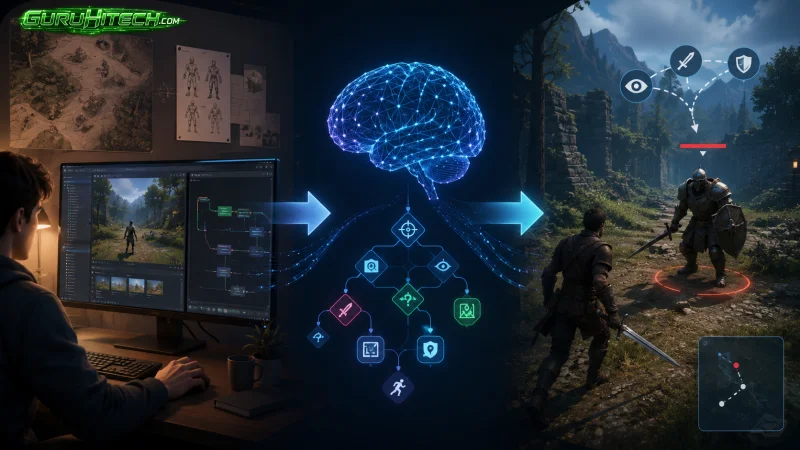
How to Make a Game With AI Logic
AI games are perfect for beginners because they rely on simple turns, easy-to-follow rules, and decision-making rather than fast reflexes. You play a hand of cards against a smart computer opponent that makes choices based on clear logic. Wins come from picking the right card at the right moment, matching numbers, beating power levels, or countering your opponent’s strategy. The result is a game that feels fair, replayable, and perfect for short 2 to 5 minute sessions.
Building one starts with basic cards, numbers or creatures with attack and health values. The computer opponent follows straightforward logic: play the strongest card available, save high-value cards for later, or counter your moves directly. Describe everything in plain language, card types, turn order, and win conditions, and the platform turns your description into a fully playable game you can share immediately. This guide walks through card types, rules, opponent logic, turn flow, balance, and testing so you can build a complete game fast.
Why Card Games Work Well for Quick Builds
Turn-based play removes timing pressure entirely. Each player draws, plays one card, and resolves its effects before the next turn begins. The opponent follows fixed rules, always beat your card if possible, or discard low-value cards early. Games end after 10 rounds or when one deck runs out. A small deck of 20 to 30 cards keeps everything manageable, and players pick up the rules on their very first turn, shifting focus to strategy almost immediately.
The broader appeal is strong: a collectible feel without actual collecting, meaningful risk-reward choices, and genuine comeback opportunities. Describe the visuals as colorful cards flipping with numbers popping on wins, and the sounds as a satisfying snap on each play with a cheer on victory. The short session length hooks casual players right away.
Pick a Basic Card Game Style
Start with either a matching or battling style. Matching: play cards to land closest to 21 without going over, with the opponent mirroring your approach. Battling: cards carry attack and health values, the highest attack wins the round, and the survivor carries into the next.
Describe the win condition clearly upfront, first to 5 round wins, or whoever empties the opponent’s deck first. Test your chosen style by playing it three times and picking the version where individual choices feel most meaningful. The style that produces the most genuine decisions is the one worth developing further.
Design Your Cards and Simple Rules
Cards need four clear properties: name, cost, power, and effect. The deck shuffles at the start, each player draws 5 cards, plays 1 per turn, and draws 1 at the end of each turn.
Core rules: player and opponent alternate turns. Each plays one card from their hand to the field, and the round resolves by comparing power, with the higher value winning the round point. Special cards can heal, draw extra cards, or modify power values. The game ends when one player reaches 10 points, or when the opponent runs out of cards.
Keep the rules forgiving for new players: ties result in both players drawing a new card, and a low hand triggers an automatic skip rather than a forced bad play.
Build Smart Opponent Logic
The opponent feels clever through rule-based decision-making rather than randomness. These logic layers give it a real personality:
- Play the highest power card available if it beats your visible play
- Hold one strong card in reserve until the final 3 turns
- If low on health, prioritize heal or draw effects over attacking
- Counter your style, if you play attack-heavy, the opponent shifts toward defense
- Occasionally discard a low card early to disguise hand strength
Describe the AI as: the opponent checks your last play and picks the best counter from its hand using the priorities above, with a 10% random factor for unpredictability. This makes the opponent feel challenging without becoming frustrating. Test by tracking win rates across 20 games, the opponent should win 40 to 60% of the time, and adjust its priorities if results fall outside that range.
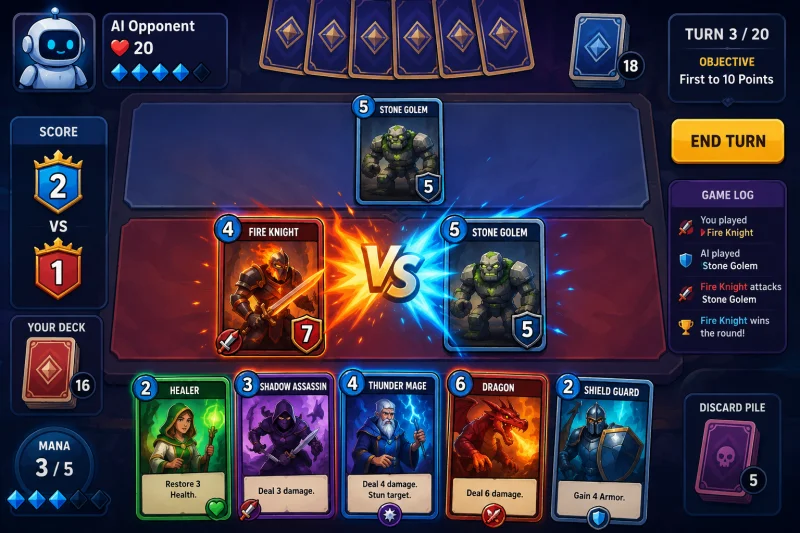
Create Smooth Turn Flow and Screen Layout
Turn sequence: your play, resolve effects, opponent play, resolve effects, draw phase. Screen layout: your hand along the bottom, the play field in the center, the opponent’s area at the top, scores on the sides, and deck piles in the corners.
Keep the layout focused, large cards for easy tapping, a glow effect on valid plays, a clear end-turn button, and auto-resolve when there’s an obvious winner. Describe it as: portrait, mobile-first, hand fanning out along the bottom, tap a card to move it to the center field. Animations: cards slide into position and explode on a winning clash. Auto-end the turn if the player is idle for 10 seconds, so the flow feels natural with no unnecessary waiting between actions.
Balance Wins and Replay Value
The player should win 50 to 60% of games when playing thoughtfully. The opponent must feel strong but consistently beatable. Balance the card power spread with common cards ranging from 1 to 5 power and rare cards from 6 to 10.
Add replay value through variation: shuffle decks differently each game, vary starting hands, and unlock new cards after wins. Offer two difficulty modes, easy with weaker opponent logic, and hard with near-perfect countering. Track win rate and average turn count across 20 test games, and if the game feels too easy, increase how aggressively the opponent prioritizes threats.
Polish With Feedback and Sounds
Every play needs satisfying feedback: cards enlarge on tap, power clashes produce a spark effect, and win-streak multipliers glow visibly. Sounds make a big difference too, a flip whoosh on card play, a clash boom on power resolution, and a victory fanfare on winning.
Keep the UI clean: large fonts, color-coded card types (red for attack, blue for defense), and a clear end screen showing the score recap, a play-again option, and share buttons. These small details make each turn feel exciting and naturally encourage players to start another round.
Test and Fix Common Card Game Problems
Playtesting catches problems that descriptions alone miss. Run through these key checks before sharing:
- Every hand always contains at least one playable card, no dead draws
- Average turn resolves in under 30 seconds
- The opponent feels neither too predictable nor too random
- Card tap areas are large enough for accurate mobile taps
To see how polished card-style mechanics and clean opponent logic feel in a finished game, play Snake io, a sharp example of how tight rules, immediate feedback, and satisfying progression come together into something genuinely replayable. Regenerate your own game after each tweak and share it with friends for honest feedback. If players ever find themselves stuck with no valid moves, add a pass option as a safety valve.
Share Your Card Game and Iterate
Publish with a thumbnail showing an exciting clash moment, two high-power cards colliding works well visually. Write a short listing description: battle a smart computer opponent with card combos, first to 10 wins. Share the link, track plays, and run a feedback loop, add requested card types, adjust balance based on comments, and release updated versions regularly.
Your card game starts basic and grows more strategic with every iteration. Describe the deck, define the rules, set the opponent priorities, generate, and play. Soon you’ll have friends competing for high scores and asking for harder difficulty modes.
Disclaimer
The information provided in this article, “How to Make a Card Game with AI Logic,” is intended for educational and informational purposes only. The concepts, strategies, and examples described are general guidelines to help beginners understand the basic process of designing a simple card game and implementing rule-based AI behavior.
Game development tools, AI platforms, and other gaming services mentioned or implied in this article may vary in features, capabilities, and requirements. Results may differ depending on the software used, programming knowledge, design decisions, and testing methods applied by the developer.
Scopri di più da GuruHiTech
Abbonati per ricevere gli ultimi articoli inviati alla tua e-mail.