
Local AI Agents: The Answer to the Automation vs. Data Control Dilemma

They were supposed to change everything. AI agents — software capable of making decisions, automating processes, and saving companies countless hours — arrived with enormous expectations. Yet according to Gartner, over 40% of AI agent projects will be abandoned by 2027. The reason is not that the technology fails. It is that companies cannot stomach sending their most sensitive data to someone else’s cloud just to make it work.
This tension between automation and data control has become the defining challenge of enterprise AI in 2026. But a different architectural approach is emerging that could resolve it entirely.
The real problem with AI agents is not the AI
The criticism that Gartner directed at the current wave of AI agents is harsh but fair. Many of these systems are repackaged RPA bots and chatbots, dressed up with an “AI” label to ride the hype. Out of thousands of solutions marketed as agent-based, only a fraction actually use advanced neural networks.
But beyond the marketing noise, there is a genuine structural problem. The agents that do work well require access to enormous amounts of operational data — customer records, internal communications, financial metrics, infrastructure logs. In most current architectures, all of that data must flow through third-party cloud services. For organizations operating under GDPR or HIPAA, this is a non-starter. The technology works, but the data model is broken.
When corporate data ends up in the cloud
The problem runs deeper than most people realize. Traditional software stores data and retrieves it on demand. AI agents do something fundamentally different: they reason over data, build persistent memory across sessions, and accumulate institutional knowledge over time. An agent that has been monitoring your infrastructure for three months does not just have your logs. It has learned your patterns, your failure modes, your operational rhythms.
When that accumulated intelligence sits on a third-party server, the company has effectively handed over a layer of its own operational understanding to an external provider. It is not just a privacy issue. It is a strategic vulnerability.
A 2026 Info-Tech Research Group survey found that 72% of IT leaders now rank data sovereignty as their top AI-related concern, up from 49% the previous year. The message is clear: companies want AI automation, but not at the cost of losing control over what their AI systems learn about them.

A different architecture: agents that stay “at home”
The solution is not to abandon AI agents. It is to run them differently. Local-first agent runtimes execute entirely on hardware the organization controls — a company server, a developer workstation, even a NAS device on the local network. The data never leaves the building. The agent’s memory, its learned patterns, its operational context — everything stays inside the perimeter.
OpenClaw, an open-source agent runtime built on this principle, shows how mature the approach has become. Agents maintain their long-term memory as transparent Markdown files anyone can inspect, rather than opaque databases in a vendor’s cloud. They support scheduled tasks, event-driven triggers, and integrations with Slack, Telegram, and GitHub — without a single byte of data leaving the organization’s infrastructure.
The key difference from old-school scripting is autonomy with guardrails. These agents can reason, plan, and act within permission scopes that define exactly what they are allowed to do. Risky actions require human approval. Every decision is logged.
Automating without overcomplicating
Gartner’s own recommendation echoes a simple truth: the problem with AI agents is not the AI itself, but how companies deploy them. Inserting autonomous agents into outdated, inefficient workflows only makes things worse. The technology should simplify, not add another layer of complexity.
This is where deployment experience matters as much as the underlying technology. Team9 AI Workspace takes the complexity out of self-hosted agent deployment entirely. There is no manual runtime installation, no security hardening checklist, no hours spent wiring up adapters and integrations. Teams can go from zero to a working agent environment in minutes and start with a single, focused use case — a morning briefing agent that summarizes overnight alerts, an automated report generator, or a monitoring bot that watches server health.
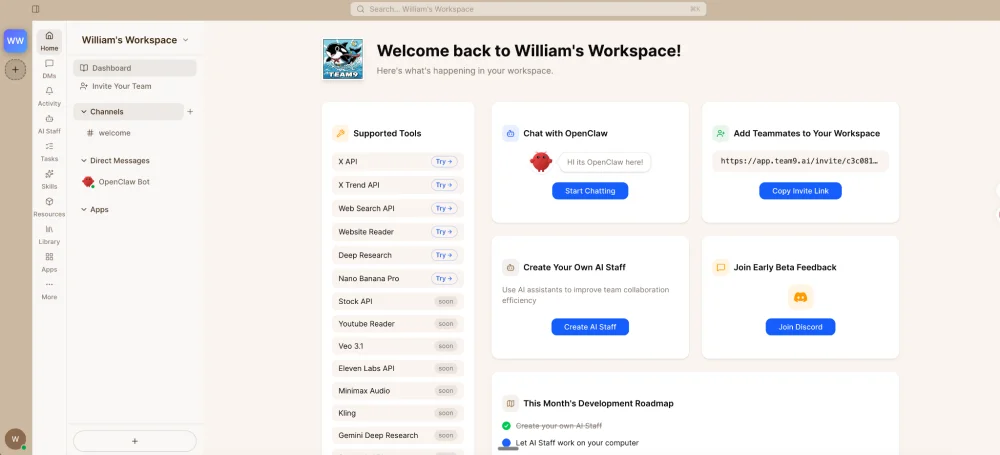
The pattern that works best mirrors what Gartner recommends: start small, measure results, expand where the data supports it. Not every process needs an AI agent. But the ones that do should not force companies to choose between automation and control over their own data.
The future of AI agents is local
Not everything about the AI agent boom has been hype. Gartner predicts that by 2028, 15% of daily work decisions will be made by AI agents, up from effectively zero in 2024. The potential is real — it just needs to be channeled with competence and common sense.
The companies that will benefit most are not the ones chasing every new trend. They are the ones deploying agents strategically, with clear objectives and full control over where their data lives. Those same agents being discarded today by companies frustrated with cloud dependencies may well return in a local-first form — more useful, more secure, and far less expensive to operate.
The question is no longer whether AI agents will matter. It is whether you will run them on your terms or someone else’s.
Sources: Gartner Hype Cycle for Emerging Technologies 2025; Gartner AI Agent Market Forecast 2027; Info-Tech Research Group, AI Trends 2026 Report.
Ti potrebbe interessare:
Segui guruhitech su:
- Google News: bit.ly/gurugooglenews
- Telegram: t.me/guruhitech
- Facebook: facebook.com/guruhitechfb
- Instagram: instagram.com/guruhitech_official/
- X (Twitter): x.com/guruhitech1
- Bluesky: bsky.app/profile/guruhitech.bsky.social
- Rumble: rumble.com/user/guruhitech
- VKontakte: vk.com/guruhitech
- MeWe: mewe.com/i/guruhitech
- Skype: live:.cid.d4cf3836b772da8a
- WhatsApp: bit.ly/whatsappguruhitech
Esprimi il tuo parere!
Ti è stato utile questo articolo? Lascia un commento nell’apposita sezione che trovi più in basso e se ti va, iscriviti alla newsletter.
Per qualsiasi domanda, informazione o assistenza nel mondo della tecnologia, puoi inviare una email all’indirizzo [email protected].
Scopri di più da GuruHiTech
Abbonati per ricevere gli ultimi articoli inviati alla tua e-mail.