
Nano Banana 2: What It Is, How It Works and What It Really Costs
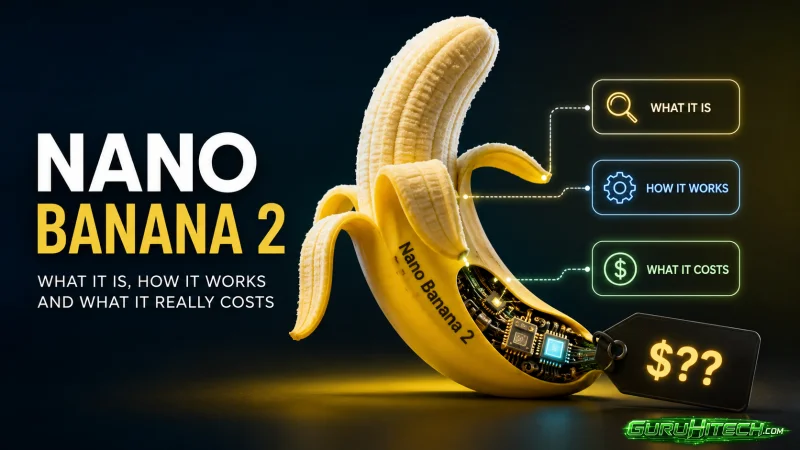
Nano Banana 2 is Google’s image generation and editing model. Its technical name is Gemini 3.1 Flash Image, and Google introduced it on 26 February 2026 as a model that pairs the quality of the Pro version with the speed of Google’s Flash line.
This guide sticks to confirmed information: resolutions, official pricing, ways to try it, and the limitations that matter.
What it can do
Nano Banana 2 creates images from text and edits images you upload. Four things stand out.
Multiple resolutions. Official documentation lists four output tiers: 512px, 1K, 2K and 4K. The 512px tier exists only on Nano Banana 2 and is meant for fast, cheap drafts.
New aspect ratios. Google added 4:1, 1:4, 8:1 and 1:8 to the existing set. These suit banners, wide headers and vertical mobile layouts.
Subject consistency. According to Google’s API documentation, Nano Banana 2 accepts up to 10 object reference images and up to 4 character references per request. Nano Banana Pro handles 6 objects, 5 characters and 3 style references.
Search grounding. The model can draw on Google Search and Google Image Search while generating, which helps when a prompt names a real place, product or event. The Lite version does not support this.
There is also a thinking control. The default is minimal, which is faster; high is intended for complex prompts and takes longer.
Pricing
Google bills images by token and publishes an effective per-image cost. These are the standard rates from the Gemini API pricing page:
| Resolution | Standard price | Batch price |
|---|---|---|
| 512px | $0.045 | $0.022 |
| 1K | $0.067 | $0.034 |
| 2K | $0.101 | $0.050 |
| 4K | $0.151 | $0.076 |
Batch requests cost half. There is no free tier on the paid API.
For comparison, Nano Banana Pro costs $0.134 per image at 1K or 2K and $0.24 at 4K. Nano Banana 2 Lite, announced on 30 June 2026, costs roughly $0.034 per image and only outputs at 1K.
How to try it
In the Gemini app. The simplest route, with no per-image charge. Open the tools menu, choose “Create images”, then pick Fast, Thinking or Pro. Google AI Pro and Ultra subscribers can regenerate a result with Nano Banana Pro from the three-dot menu.
In Google AI Studio or via the API. The route for developers and volume production. The model IDs are gemini-3.1-flash-image for Nano Banana 2, gemini-3-pro-image for Pro and gemini-3.1-flash-lite-image for Lite.
With a third-party web tool. Several online services call the model through the API and add presets, credit management and export options. Platforms such as Nano Banana 2 fall into this group. They are independent products, not run by Google, so check credit costs and commercial-use terms before subscribing.
Availability and watermarking
Google Cloud confirmed general availability for Nano Banana 2 and Nano Banana Pro on 28 May 2026, but only for 1K and 2K output. 4K remains in preview: it works, but it is not covered by the same service guarantees.
Every generated image carries an invisible SynthID watermark plus a visible marker. Google says its SynthID verification tool has been used more than 20 million times since November, and that C2PA Content Credentials support is being added to the Gemini app.
Limitations worth knowing
The first is the visible watermark on consumer output. If you need a clean file, you generally have to move to the paid API.
The second is 4K still being in preview. For a professional workflow that needs guaranteed continuity, that is a risk to weigh.
The third is style. Nano Banana 2 has no dedicated style reference slot; Nano Banana Pro offers up to three. Anyone maintaining one visual style across dozens of images will feel that gap.
Finally, the naming is confusing. Nano Banana 2, Nano Banana Pro and Nano Banana 2 Lite are three different models at three different prices. Pro is not a later version of 2 it is built on Gemini 3 Pro Image, while Nano Banana 2 is built on Gemini 3.1 Flash Image.
Conclusion
Nano Banana 2 is the most balanced option in the family: solid quality, four resolutions, useful aspect ratios and a modest cost. Anyone working on complex illustrations with many characters, or holding a fixed visual style, should look at Nano Banana Pro. Anyone generating thousands of simple images should look at Lite. For most other cases, version 2 covers the ground well.
Ti potrebbe interessare:
Segui guruhitech su:
- Google News: bit.ly/gurugooglenews
- Telegram: t.me/guruhitech
- Facebook: facebook.com/guruhitechfb
- Instagram: instagram.com/guruhitech_official/
- X (Twitter): x.com/guruhitech1
- Bluesky: bsky.app/profile/guruhitech.bsky.social
- Rumble: rumble.com/user/guruhitech
- VKontakte: vk.com/guruhitech
- MeWe: mewe.com/i/guruhitech
- Skype: live:.cid.d4cf3836b772da8a
- WhatsApp: bit.ly/whatsappguruhitech
Esprimi il tuo parere!
Ti è stato utile questo articolo? Lascia un commento nell’apposita sezione che trovi più in basso e se ti va, iscriviti alla newsletter.
Per qualsiasi domanda, informazione o assistenza nel mondo della tecnologia, puoi inviare una email all’indirizzo [email protected].
Scopri di più da GuruHiTech
Abbonati per ricevere gli ultimi articoli inviati alla tua e-mail.