
Software Development Outsourcing: Models, Benefits & Best Practices
Developing software on one’s own may not be the quickest or most economical way to reach the market. With growing complexities in technical demands, particularly the increase in the development of enterprise-level AI software, every business of any size is now looking towards external sources of help. Outsourcing of software development is no longer a tool for reducing costs but an essential strategy for any business that wants to compete without overburdening its internal resources.
In this guide, we cover all the major outsourcing options and how to select the best outsourcing partner.
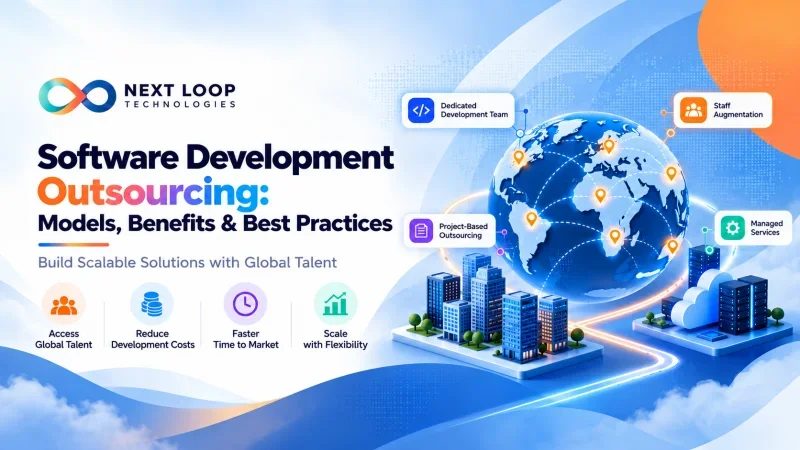
What Is Software Development Outsourcing?
In software development outsourcing, one entrusts an external entity with designing, building, testing, and maintaining software rather than doing everything internally. It may be anything from a feature to full-fledged product creation. It applies to different outsourcing scenarios of software development — local, nearshore, and offshore.
There can be many reasons to use software development outsourcing, including limited internal resources, specialized expertise requirements (for example, AI/ML development), fast time-to-market, or keeping a small number of employees while adjusting the delivery capacity as needed.
Common Software Development Outsourcing Models
It is obvious that there is no universal formula for outsourcing. The right software development outsourcing model should be selected depending on numerous aspects such as project scale, deadline, cost and necessary degree of control.
1. Project-based outsourcing
This approach implies outsourcing a clearly defined project, which has its own scope, deliverables and timeframe to complete to the outside vendor. The vendor will manage the process, the team and delivery of the results, and you’ll pay either flat or milestone fees.
Good for: Clearly defined projects with static requirements like developing MVP, an application module, a system migration etc.
Trade-offs: Limited flexibility due to the fact that changing the scope usually implies negotiating on costs and timeframes.
2. Staff augmentation
It is a practice of engaging outside developers, who will perform their duties as an extension of your team.
Good for: Your company if it already has the processes but lacks people or expertise (AI engineers, DevOps experts etc.)
Trade-offs: You’ll have to engage into more direct supervision than when managing a project team.
3. Dedicated Development Team
Model that involves an outsourcing partner building out the entire team of people – developers, QA and project managers – who work solely on your product, usually for the long run. In this scenario, you retain control over the strategy, but it is the partner that takes care of human resources. Best suited for: Projects for the long term, feature development, companies requiring a stable outsourcing team.
4. Managed Services / Outsourced Product Development
In this model, the outsourcing partner practically takes over: makes decisions about architecture and delivery processes, and sometimes even provides maintenance services. This type of outsourcing partnership is popular when dealing with complex and highly specialized outsourcing tasks (e.g. AI modeling).
It’s important to remember that when choosing among these models, there is usually no such thing as “best outsourcing” model – only the right one for your particular situation.

Why Companies Choose Outsourced Software Development
Cost efficiency – The cost of hiring and retaining full-time engineers is very high, particularly those with niche expertise such as AI/ML. Outsourcing helps convert fixed costs to variable costs and access cheaper labor markets.
Access to specialized talent – Enterprises that want to embark upon AI initiatives require experience with large language models, MLOps, data pipelines, and domain-specific fine-tuning, which is hard to get and expensive if hired on a full-time basis. An outsourcing software development firm can help with such knowledge on an ad-hoc basis.
Reduced time-to-market – Outsourcing companies can sometimes start working right away, work in parallel with your schedule and quickly ramp up – thus reducing the time it takes to go from idea to implementation.
Flexibility and scalability – You can scale up the team during the sprint and scale it back down when the work is completed without the hassle of firing and keeping inactive people on the payroll.
Focused core business – Outsourcing allows focusing on strategy, customer relationships, and growth without dealing with engineering project management.
Such organizations as Nextloop Technologies base their entire business model on exactly this requirement – offering flexible ways to engage and sufficient expertise for proper outsourcing instead of a last-resort solution.
Communication: The Key to Success
Bad communication is the main reason for outsourced projects to be unsuccessful. Here are some of the methods that help differentiate successful cooperation from difficult one:
Overlap work schedules, if possible, especially with remote teams in distant time zones.
Use standardized tools – common project management boards, version controls, and communication mediums (Slack, Jira, etc.) right from the start.
Maintain the practice of conducting daily stand-ups, weekly demonstrations, and sprint review meetings so that any misalignments become evident before delivery.
Document everything – requirements, decisions, and architecture so that knowledge isn’t confined to one’s brain.
Designate a point of contact on both ends to prevent ambiguity.
Outsourcing firms such as Nextloop Technologies that have structured their communication process during delivery have been known to face much less scope conflict and rework cycles.
Security considerations you can’t afford to overlook
Handing code, data, or infrastructure access to an external team introduces real risk if not managed carefully.
- Use NDAs and IP agreements before any technical discussion begins.
- Apply least-privilege access — give vendors only the systems and data they need, nothing more.
- Vet compliance posture — for regulated industries, confirm the vendor’s familiarity with standards like SOC 2, GDPR, or HIPAA.
- Audit code and infrastructure practices — ask about their secure coding standards, code review process, and dependency management.
- Plan for offboarding — revoke access and rotate credentials immediately once the engagement ends.
Security due diligence should happen before signing, not after a breach.
Understanding the Real Costs
Outsourcing costs vary widely depending on region, model, and complexity:
| Factor | Impact on Cost |
| Engagement model | Staff augmentation is typically priced hourly; project-based work is fixed or milestone-based |
| Location | Offshore development is generally cheaper than nearshore or onshore, but rate isn’t the only variable |
| Talent specialization | AI/ML and enterprise architecture skills command premium rates |
| Team structure | Dedicated teams cost more upfront but reduce long-term hiring risk |
The lowest-cost choice is not always the highest value. Take into account communication costs, inefficiencies, and quality – the cheaper cost per hour, which results in longer completion times or code debt, ends up costing more over time.
How to Choose the Right Outsourcing Vendor
- Check technical depth, not just portfolio size. Ask for case studies relevant to your specific need — especially for specialized work like enterprise AI systems.
- Evaluate their process, not just their people. Ask how they handle requirements gathering, QA, and change requests.
- Start small. A pilot project or a two-week trial sprint reveals more about fit than any sales pitch.
- Check references directly. Talk to past clients about communication quality, timeline adherence, and how issues were handled.
- Confirm cultural and time zone compatibility. This affects daily collaboration more than most buyers expect.
- Establish ownership rights and agreements before beginning. Make certain that the code, data, and deliverables are clearly yours.
Vendors such as Nextloop Technologies that provide a combination of flexible engagement models, including projects, staff augmentation, and dedicated teams, along with enterprise AI capabilities, should be considered because of their ability to customize the model according to the project requirements.
Final Thoughts
The process of enterprise AI software development does not have only one way. It is necessary to decide whether a project-based outsourcing will work better for your case or some other method should be used. Success ultimately comes down to three things: choosing the right model, communicating rigorously, and vetting vendors on security and technical depth, not just price.
Done well, outsourcing isn’t a compromise — it’s a way to build better software, faster, with access to expertise that would be difficult or expensive to build in-house alone.
FAQs
1. What are the differences between staff augmentation and project-based outsourcing?
Staff augmentation involves recruiting external developers to integrate them into your team, whereas project-based outsourcing delegates the whole scope of the project to the contractor.
2. Can offshore software development be considered safe for confidential projects?
Yes, if you make sure that there are proper security measures taken, including NDA, least privilege, compliance check, and offboarding process. The safety of the project doesn’t depend on location but on the processes you take.
3. How expensive can software development outsourcing be?
It differs depending on the region, approach, and type of skills needed. Staff augmentation is priced on an hourly basis, while the rest is either fixed-price or milestone-based pricing. Skilled specialties like AI engineering cost more.
4. How to select the best software development outsourcing partner?
Find a partner with technical expertise, ask for references, start with a pilot project, and ensure intellectual property ownership and a clear communication process.
5. Can outsourcing work for enterprise AI software development specifically?
Yes — in fact, it’s one of the most common use cases today, since AI/ML talent is scarce and expensive to hire full-time. Partnering with a vendor experienced in enterprise AI reduces the learning curve and speeds up deployment.
Ti potrebbe interessare:
Segui guruhitech su:
- Google News: bit.ly/gurugooglenews
- Telegram: t.me/guruhitech
- Facebook: facebook.com/guruhitechfb
- Instagram: instagram.com/guruhitech_official/
- X (Twitter): x.com/guruhitech1
- Bluesky: bsky.app/profile/guruhitech.bsky.social
- Rumble: rumble.com/user/guruhitech
- VKontakte: vk.com/guruhitech
- MeWe: mewe.com/i/guruhitech
- Skype: live:.cid.d4cf3836b772da8a
- WhatsApp: bit.ly/whatsappguruhitech
Esprimi il tuo parere!
Ti è stato utile questo articolo? Lascia un commento nell’apposita sezione che trovi più in basso e se ti va, iscriviti alla newsletter.
Per qualsiasi domanda, informazione o assistenza nel mondo della tecnologia, puoi inviare una email all’indirizzo [email protected].
Scopri di più da GuruHiTech
Abbonati per ricevere gli ultimi articoli inviati alla tua e-mail.